.png&w=3840&q=75)
From Capability to Opportunity: Understanding the Difference Between Mentorship and Sponsorship
Sep 7, 2026
Introduction: Career Advancement Takes More Than Capability
Career advancement rarely depends on individual performance or skillset alone. Talent development and advancement happens through organisational communities (mentors and sponsors) that ensure capability, visibility, access and advocacy. According to Gallup, employees with a mentor or sponsor are twice as likely to strongly agree that their organisation provides a clear career plan for talent development, and advancement.
Mentorship and sponsorship are correlated and yet fundamentally distinct. While both are essential for career advancement, mentors and sponsors act primarily in different ways.
What is Mentorship and Sponsorship?
Mentorship focuses on building talent capability and unlocking potential with confidence to navigate careers. On the other hand, sponsorship opens doors to opportunities through visibility, advocacy, and access.
Both mentorship and sponsorship support career advancement by building and strengthening leadership pipelines.
Mentorship: Enables Employees to Navigate their Career Paths
At its heart, mentorship answers the below question:
“How can I enable an employee to prepare for what comes next?”
The outcome of mentorship focuses on stronger capability, confidence, and employee readiness.
- A mentor enables an employee towards:
- Build knowledge and skills
- Think through career decisions
- Receive feedback
- Navigate workplace challenges
- Build confidence
- Identify development opportunities
- Prepare for future roles
A mentor can ask questions, offer feedback, share lessons from their own experience and support an employee to understand possible career paths. In fact, formal mentoring can support in career development, performance conversations, and map employee strengths with organisational opportunities.
Mentorship → Capability → Employee Readiness
Sponsorship: Enabling Employees To Move Forward
At its heart, sponsorship answers the below question:
“How can I create access to opportunities that enable you to advance?”
The outcome of sponsorship focuses on stronger visibility, access, and career advancement.
A sponsor enables an employee:
- Gain visibility
- Access influential networks
- Get considered for opportunities
- Receive recommendations
- Take on stretch assignments
- Gain advocacy in advancement discussions
A sponsor uses their influence, credibility and networks to advocate for an individual's advancement. This could mean recommending for a stretch assignment, putting their name forward for a promotion, introducing them to influential decision-makers or advocating for them during talent and advancement discussions.
Sponsorship → Visibility → Opportunity → Advancement
Mentorship vs. Sponsorship: What really changes?
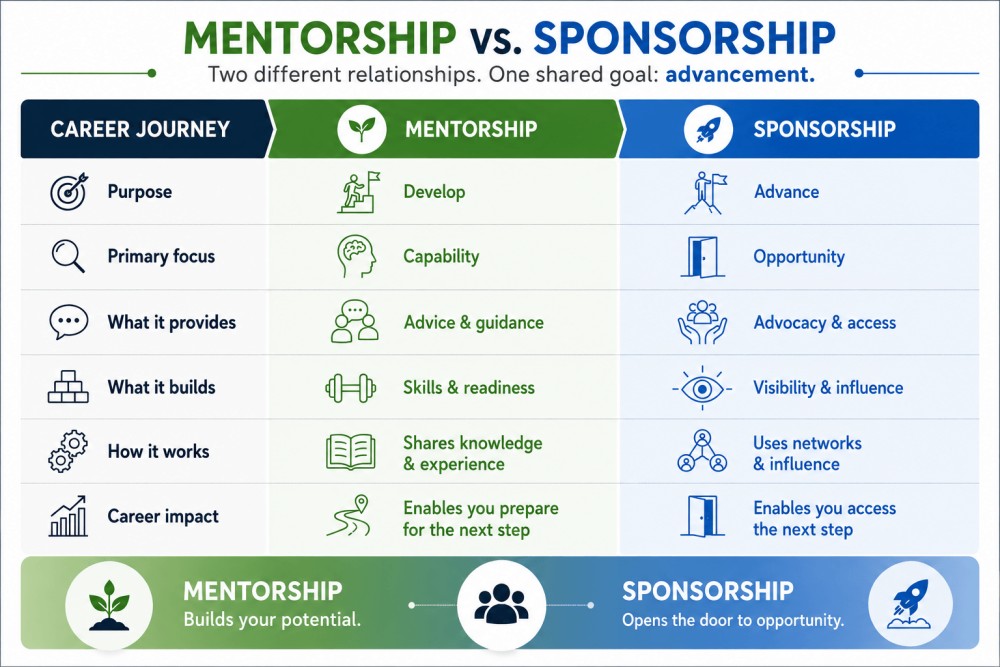
Mentorship and sponsorship serve different purposes and can be integrated as part of a broader talent-development strategy.
Building Mentorship and Sponsorship into Organisational Culture
The measure of successfully integrating mentorship and sponsorship must be based on outcomes rather than participation:
Who received stretch opportunities?
Who gained greater leadership visibility?
Who progressed into new roles?
Are advancement opportunities becoming more equitable?
Are employees experiencing stronger career development?
Organizations that want to build stronger and more inclusive leadership pipelines need to do more than develop talent. They must create pathways for talent to be
seen, supported, and acted upon.
#Mentorship #Sponsorship #CareerAdvancement #TalentDevelopment #LeadershipDevelopment #CareerGrowth #InclusiveLeadership #DEI #EmployeeDevelopment #LeadershipPipeline #CareerOpportunities #WorkplaceInclusion
By Sandra Sebastian, Interweave Consulting Pvt. Ltd.