Emotional and Digital Harassment: The Grey Areas We Can No Longer Ignore
Introduction — Harassment Beyond What the Law Can See
The modern digital era forces one to rethink and redefine workplace harassment. It is seemingly apparent that a decade ago framed Prevention of Sexual Harassment compliance laws leaves gaps and loopholes when it comes to digital / virtual harassment. The leverage of digital platforms has led to nuances of emotional harassment both online and offline. Thus, many survivors and bystanders struggle to speak out and intervene against emotional and digital harassment.
As workplaces become more hybrid along with digital communication as a norm, these invisible struggles are layered with power dynamics. The “grey zones” of the PoSH Act in the workplace can mean a rapid rise in cases where misconduct is apparent and yet left unworthy of notice - emotional coercion, digital and AI enabled misconduct, and failure to report trauma due to rigid timelines as per the PoSH Act are some of the nuances we will delve further in this blog.
Towards the end of 2025, let’s reflect together on how ignoring the “grey zones” comes at a significant cost - including at the employee, manager, and organisational level. The humane impact of the PoSH Act calls for a strengthening in today’s times indeed.
What the POSH Act Covers — And Where It Falls Short
In 2013, workplace demands meant the establishment of the PoSH Act, a landmark step in combatting workplace sexual harassment. It clearly defined in legal terms the definition of a workplace in its broader context, the constitution of sexual harassment, laid progressive measures of internal committee mechanisms, and mandated employer responsibility.
And yet, invisible loopholes as tangibles remain, including how the focus lies primarily on evident criteria - those explicit acts that become the legal anchoring of the PoSH Act, perhaps unwelcome advances, physical gestures, verbal remarks, etc.
These invisible tangibles include the below:
1. Social Media interactions - While organizations encourage social media interactions amongst colleagues, there is a lack of clarity on balancing professionalism, using discretion and drawing boundaries when it comes to such interactions. Seemingly ‘convenient’ professional interactions could soon cross a boundary. It becomes difficult in situations of unequal power, when a supervisor engages in interactions over social media platforms including WhatsApp.
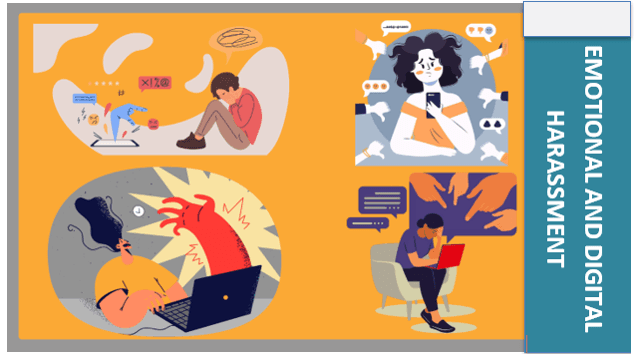
It doesn’t always show up as explicit messages or obvious threats — sometimes it arrives as a constant buzz of notifications: persistent pings, late-night texts, or “just checking in” messages that slowly create a sense of being watched. What looks like simple communication can quickly become digital surveillance, with someone monitoring your activity across platforms, tracking when you’re online, or combing through your posts and interactions.
Examples include: A junior employee trying to avoid displeasing a senior, a student avoiding jeopardising the educator as it could impact grades or future interactions, or a team under pressure to welcome advances unsolicited as it may impact project opportunities.
Emotional dependence can constitute a survivor depending on the perpetrator for advice, validation or career support. This factor further complicates such interactions, making it difficult for subordinates to draw boundaries on social media interactions.
2. Emotional harassment: Rarely does emotional harassment announce itself as abuse is not apparent - no raised voices, explicit threats or inappropriate messages. Instead, it can slowly erode one’s self worth and confidence. It can show up as guilt-tripping disguised as concern, affection turning into pressure, support offered one day and withdrawn the next, or unpredictable behaviour that keeps the survivor constantly anxious about “what comes next.”
Seen as a pattern, it creates a climate in which the survivor feels compelled to agree or stay silent. Over time, this form of mistreatment:
- erodes autonomy, making the person doubt their own judgment,
- creates emotional dependence, where reassurance is controlled and weaponised,
- undermines confidence, making the survivor feel “too sensitive” or “overreacting,” and
- restricts agency, as decisions and boundaries become harder to assert.
In workplaces, this may take the shape of subtle retaliation — withholding guidance, stalling approvals, threatening poor evaluations, or hinting at professional consequences if personal or emotional expectations are not met. It leaves no screenshots, no recordings, no visible evidence, yet its impact is profound: anxiety, self-doubt, hypervigilance, and the collapse of psychological safety.
And because it doesn’t fit neatly into the POSH Act’s more explicit definitions, emotional harassment is often the abuse that slips through the cracks — unseen, unrecorded, and unaddressed.
3. Digital and AI-enabled misconduct: Harassment today has quietly moved into the digital shadows. Digital stalking — subtle but invasive — where personal and professional boundaries dissolve as someone follows, screenshots, or archives your online footprint. Even private conversations aren’t safe; screenshots can be twisted, weaponised, or used to coerce silence.
But the most alarming shift comes from technology itself. AI-enabled abuse—deepfakes, edited photos, voice cloning, manipulated images—can destroy reputations in seconds. A survivor can find themselves trying to prove that something never happened, with no clear legal path or organisational process to support them.
These tech-driven behaviours slip through the cracks of traditional harassment definitions. They create emotional distress, reputational risk, and psychological pressure — yet most workplace policies, including POSH, were never built to recognise or address harm created by algorithms, screens, and digital footprints.
4. Rigid timelines: The law may give survivors 120 days to file a complaint — but trauma doesn’t follow a calendar. Emotional and digital harassment often unfold slowly, confusingly, and in ways that take time to even recognise as abuse. Many survivors spend months, sometimes years, trying to make sense of what happened: Was it really harassment? Did I encourage it? Will anyone believe me? What will it cost me if I speak up?
Shame, fear of retaliation, career repercussions, and the deeply subtle nature of grey-zone behaviour often delay reporting — not because the harm is minor, but because it is complex. Yet rigid legal timelines demand that these layered, emotional journeys fit neatly into a narrow window. When Internal Committees dismiss delayed complaints as “too old,” the message is clear: the law’s clock matters more than the survivor’s experience.
Instead of protecting people, these deadlines often silence them. And in cases rooted in emotional coercion or digital manipulation — where the harm is ambiguous, private, or psychologically confusing — survivors may not even realise they have a case until the window has already closed.
Rigid timelines don't just limit justice; they actively discourage it.
Institutional Blind Spots — Why ICs Struggle With Grey-Zone Harassment
Most Internal Committees were built for a world where harassment was assumed to be explicit, event-based, and easy to categorise. They are trained to evaluate clear incidents — a message, a remark, an unwelcome gesture. But grey-zone harassment doesn’t work that way. It unfolds quietly: through layered consent, subtle coercion, emotional manipulation, and digital behaviour that leaves behind fragments rather than full stories.
ICs often lack the tools and training to interpret these patterns.
- They are not equipped to analyse digital evidence such as metadata, message frequency, tone shifts, or AI-generated content.
- They rarely receive training on emotional abuse, psychological manipulation, or boundary violations disguised as mentorship or care.
- Their processes remain rooted in rigid timelines and checklist-driven inquiries, which can unintentionally work against survivors who need time to process trauma.
The result? Many cases fall through the cracks — not because the harm is unclear, but because the system is not designed to detect it.
What Organisations Must Do — Closing the Gap Before More Harm Occurs
If workplaces want to be genuinely safe, not just technically compliant, they must evolve faster than the harm itself.
1. Update POSH and Anti-Harassment Policies
Policies must explicitly recognise emotional harassment, digital misconduct, and AI-enabled abuse such as deepfakes, fabricated screenshots, impersonation, and coercive communication patterns.
2. Introduce E-Codes of Conduct for Hybrid Workplaces
Remote and hybrid work environments need clear standards for digital etiquette, messaging boundaries, call behaviour, recording norms, and acceptable communication practices.
3. Upskill ICs for Today’s Realities
ICs must be trained in:
- Patterns of emotional coercion
- Layered consent
- Trauma-informed inquiry
- Digital forensics and evidence preservation
- Evaluating screenshots, metadata, chat logs, and AI manipulation
4. Build Safer, Confidential Reporting Channels
Digital reporting tools that allow survivors to gather evidence, log patterns, or raise concerns anonymously can reduce fear and improve early intervention.
These steps transform the IC from a reactive body into a proactive, survivor-centred safeguard.
Conclusion — Naming the Grey Makes Prevention Possible
Emotional and digital harassment thrive in the spaces our laws and systems fail to recognise. The first step toward change is naming these behaviours clearly — acknowledging that harm is not always loud, explicit, or physical.
Workplaces must now move beyond compliance and into the realm of genuine psychological safety. This means stronger laws, deeper training, nuanced investigations, and an unwavering commitment to creating environments where people feel protected, heard, and respected.
When organisations close the grey areas, they don’t just prevent harassment — they build cultures where dignity is non-negotiable.
By Sandra Sebastian, Interweave Consulting Pvt. Ltd.
#EmotionalHarassment #DigitalHarassment #WorkplaceSafety #PsychologicalSafety #InclusiveWorkplaces #HarassmentAwareness #SafeWorkplaces #RespectAtWork #POSH #WorkplaceWellbeing #TraumaInformed #SpeakUpCulture #InterweaveConsulting